For years, the fintech industry has been asking a relatively narrow question about AI: how can a financial app become smarter?
That question produced a familiar product pattern. Banks, brokers, and wealth managers added AI assistants to summarize research, answer account questions, draft advisor notes, scan portfolios, or help users build investment ideas. In that model, AI lives inside the financial institution. The firm controls the assistant, the data, the compliance perimeter, and the user experience.
Robinhood’s new agentic trading launch points to a different question: what if the AI does not belong to the broker at all?
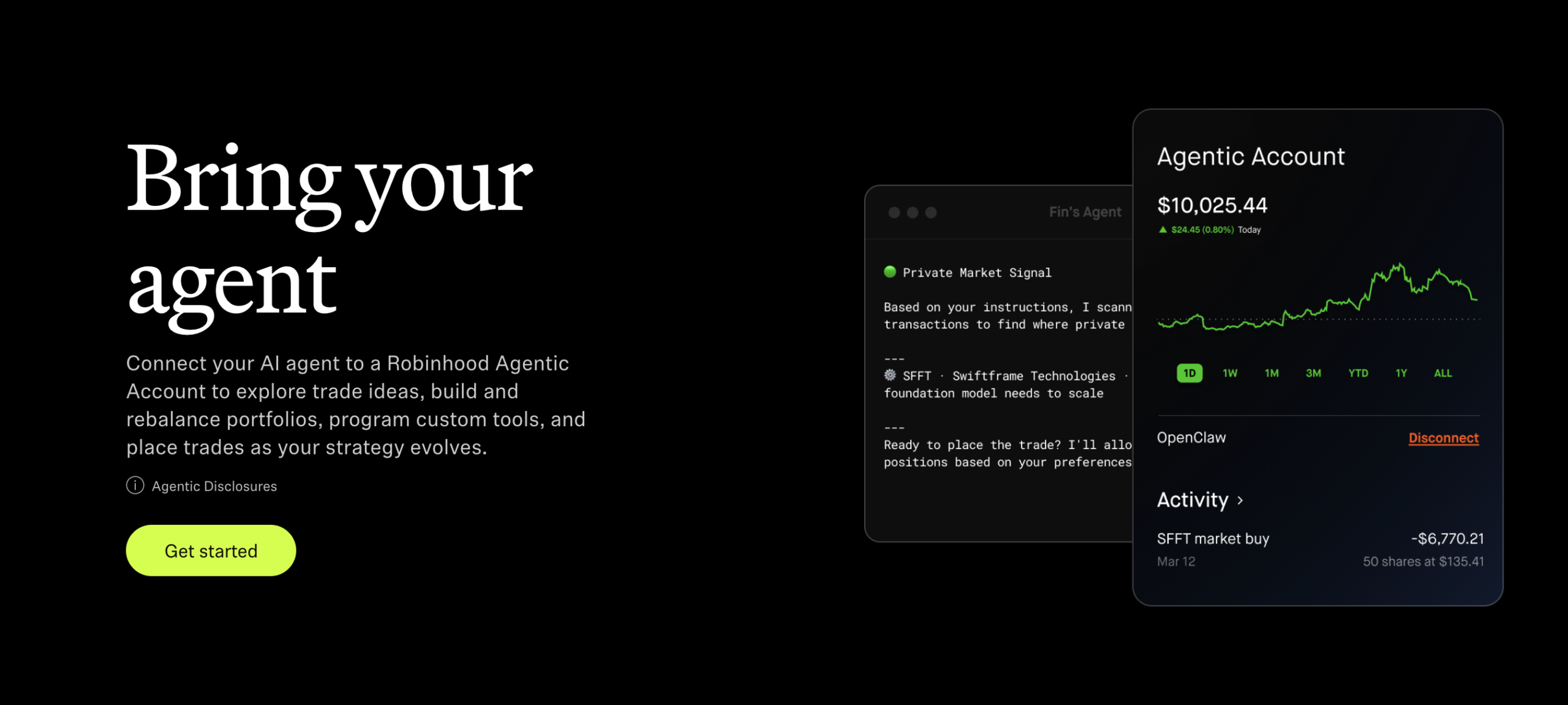
On May 27, Robinhood announced Agentic Trading, allowing customers to connect third-party AI agents to a dedicated Robinhood account. The agent can access that separate account, place equity trades, and operate within user-defined limits. Robinhood also announced an Agentic Credit Card, where agents can make purchases through a dedicated virtual card with spending controls.
That may sound like another AI feature. It is more than that. It is a strategic fork in the road for fintech.
The next battle may not be “which financial app has the best AI assistant?” It may be: will your financial AI be a managed assistant inside your brokerage, or a bring-your-own agent that uses your brokerage as infrastructure?
The Old Fintech AI Playbook
The first wave of AI in finance has mostly been controlled and institution-led.
Morgan Stanley is a good example. Its AI @ Morgan Stanley Assistant gives financial advisors access to the firm’s internal knowledge base, while AI @ Morgan Stanley Debrief can summarize client meetings, surface action items, and draft follow-up communications. This is powerful, but it is also highly managed. The AI helps the advisor operate more efficiently inside Morgan Stanley’s environment.
JPMorgan’s IndexGPT ambitions point in a similar direction: an institution-controlled AI layer for investment insight and advice-like experiences. Public, meanwhile, has pushed AI into the consumer brokerage interface, letting users create investable indexes with AI and planning AI-powered portfolio management features.
These products differ in audience and execution, but they share a basic assumption: the financial firm owns the AI interface.
That makes sense. Finance is regulated, high-trust, and high-risk. A managed assistant lets the institution supervise the model, constrain the outputs, maintain logs, shape the UX, and keep the customer inside its own environment. For banks and brokerages, this is the comfortable path: AI as a feature, not AI as an outside actor.
Robinhood’s Different Bet
Robinhood’s approach is more radical because it treats the AI agent as something the customer may bring from elsewhere.
With Agentic Trading, Robinhood is not simply saying, “Use our AI to trade.” It is saying, “Connect your agent to us.” The company says users can bring agents from anywhere and connect them through Robinhood’s AI-native MCP servers. The agentic account is separate from the rest of the user’s portfolio, and the agent only has access to funds deposited into that dedicated account. Users get push notifications, a real-time activity feed, profit-and-loss visibility, and the ability to disconnect the agent.
That architecture matters. It turns Robinhood into an execution and permissioning layer for external intelligence.
In the managed-assistant model, the financial institution is the brain and the broker. In the bring-your-own-agent model, the broker becomes the place where an outside brain gets authorized to act.
This is the deeper shift. Robinhood is not only launching AI trading. It is opening the brokerage account to agentic software.
The Strategic Tradeoff
The core tradeoff is control versus openness.

A managed assistant gives the financial institution more control. It can shape the user journey, manage risk, and monetize the AI layer directly through subscriptions, advisory services, or higher engagement. But it may be less flexible and less personalized because it only knows what the institution lets it know.
A bring-your-own-agent model gives users and developers more freedom. It makes finance programmable. But it introduces harder questions: What happens when an agent misinterprets instructions? Who is responsible if it trades on stale or incomplete information? How should a broker evaluate an agent it does not control? What data leaves the broker’s environment? How does the user know what the agent actually did?
Robinhood’s own disclosures make this tension clear. The company says AI agents may make errors, misinterpret instructions, or behave unexpectedly, and that Robinhood does not control, supervise, monitor, recommend, or audit third-party agents. That is the point and the problem. The openness is what makes the product novel, but it also shifts more responsibility to the user.
So the most important product features may not be the trading strategies. They may be the boundaries: dedicated accounts, funding limits, activity feeds, notifications, previews, manual approvals, and instant disconnect buttons.
In agentic finance, the kill switch is not a detail. It is the product.
The Shifting Moat in Fintech
The next fintech moat may not be the chatbot itself.
Every bank and broker can eventually add a conversational assistant. The harder and more durable infrastructure may be the permissioning layer around autonomous financial action. Who can act? On which account? With what budget? Under what limits? With what audit trail? Can the user reverse, pause, dispute, or understand the action afterward?

That is where the real competition may move.
Managed-assistant firms will argue that trust requires control. They will say financial AI should be supervised, institution-grade, and embedded in a regulated environment.
Bring-your-own-agent platforms will argue that users should control their own AI stack. They will say the future is interoperability: one agent, many tools, user-defined permissions, and portable intelligence.
Both models will probably coexist. Wealth management may lean toward managed assistants because trust, compliance, and human oversight matter deeply. Active retail trading may experiment faster with agentic access because its users are already comfortable with tools, automation, and self-directed risk. Payments and commerce may move fastest of all, because spending limits and virtual cards are easier to sandbox than investment accounts.
But Robinhood’s move makes the strategic question unavoidable.
For the past decade, fintech companies competed to become the app where consumers manage money. In the AI era, they may compete to become the system that agents are allowed to use.
The question is no longer whether fintech apps will have AI assistants. They will.
The question is who owns the assistant: the financial institution, the user, or the AI platform sitting above them both?
One response to “The Next AI Battle in Fintech: Robinhood Introduces Bring-Your-Own Agent Model”
Hi, this is a comment.
To get started with moderating, editing, and deleting comments, please visit the Comments screen in the dashboard.
Commenter avatars come from Gravatar.